
Proactive Threat Hunting 2026: Advanced Methodologies & Frameworks
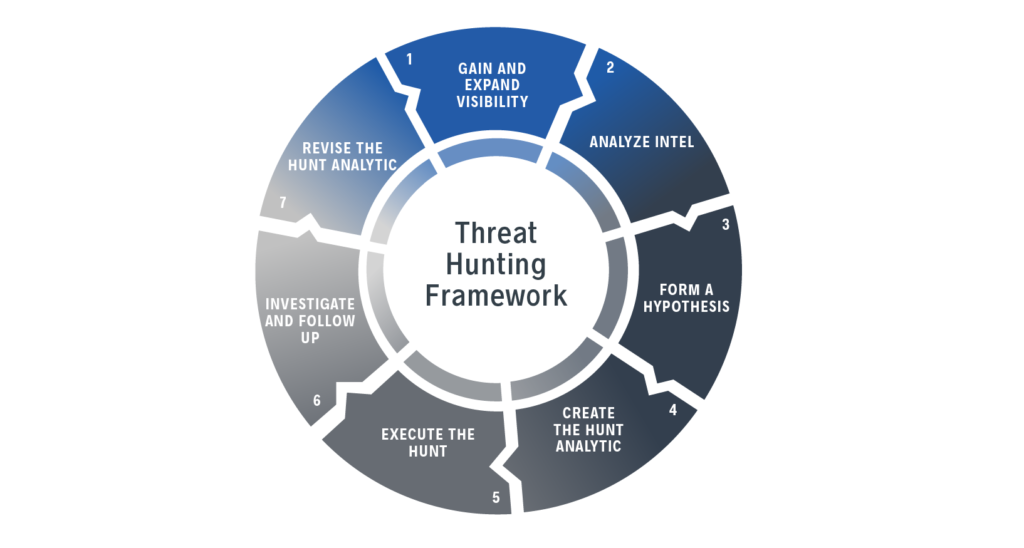
Hunting the Invisible: Advanced Proactive Threat Hunting Methodologies for 2026
The fundamental philosophy of Asguardian Shield is “Assume Breach.” Even with a perfectly tuned SIEM and a state-of-the-art NGFW, there are gaps. Traditional security tools are designed to catch “known bad” patterns; Threat Hunting is designed to find the “unknown bad.”
In 2026, threat hunting is no longer a luxury for elite SOCs—it is a mandatory Advanced Ops function. It requires a pivot from looking at what an attacker does (indicators) to how an attacker thinks (tactics, techniques, and procedures).
What is Proactive Threat Hunting? (AEO Summary)
Direct Answer: Proactive Threat Hunting is the iterative process of searching through networks, endpoints, and cloud datasets to detect malicious activity that has evaded existing automated security controls. Unlike incident response, which is triggered by an alert, threat hunting begins with a Hypothesis. Analysts use their knowledge of adversary behavior (TTPs) and environment-specific telemetry to find “weak signals” of compromise, such as unusual lateral movement or unauthorized API calls.
1. The Three Core Hunting Methodologies
Effective hunting isn’t aimless “browsing” of logs; it is a structured scientific process. At Asguardian Shield, we utilize three primary methodologies:
A. Hypothesis-Driven Hunting
This is the most common and effective method. It starts with a question: “If an attacker were in our environment, how would they hide?”
- The Source: New threat intelligence, recent high-profile breaches, or the MITRE ATT&CK framework.
- Example: “I suspect an adversary is using DLL Side-Loading to maintain persistence on our finance servers.”
B. Intel-Based Hunting (IOC Hunting)
This is a reactive-proactive hybrid. You take “atomic” indicators (IPs, MD5 hashes, domains) provided by threat feeds and search your historical logs to see if those indicators appeared before the feed was updated.
- Limitation: In 2026, this is the least effective method because attackers rotate infrastructure every few hours.
C. Behavioral/Analytics-Based Hunting
This method looks for deviations from the “norm” without a specific hypothesis.
- Technique: Using Least-Frequency Analysis (Stacking). By “stacking” every unique process running across 5,000 workstations, the 4,995 instances of
chrome.exedisappear, leaving the 5 instances ofcrome.exe(a common typo-squatting trick) exposed for investigation.
2. Advanced Ops: The PEAK Hunting Framework
In 2026, we have moved beyond the basic “OODA Loop” to the PEAK Framework (Prepare, Execute, Act, Knowledge), which ensures every hunt results in a permanent security improvement.
1. Prepare
Define the scope and gather the “Tools of the Hunt.” This involves ensuring your SIEM Tuning is optimal so you are searching through high-quality data.
2. Execute
This is the investigation phase. Analysts use EDR, NDR, and Cloud-native logs to prove or disprove the hypothesis. We look for “Telltale Heart” artifacts:
- Persistence: Unfamiliar scheduled tasks or WMI event consumers.
- Lateral Movement: Successive RDP or SMB connections between workstations that don’t normally communicate.
- Data Exfiltration: Unusual DNS query volumes or large outbound HTTPS POST requests to unfamiliar domains.
3. Act
If a threat is found, the hunt immediately transitions into an Incident Response Playbook. If no threat is found, the hunt is still successful because it confirms the “Negative.”
4. Knowledge
This is the most critical step. The findings from the hunt are used to Automate Future Detection. If a manual hunt found a suspicious PowerShell pattern, that pattern is turned into a permanent SIEM correlation rule so a human never has to “hunt” for it again.
3. Comparison: Traditional Monitoring vs. Proactive Hunting
| Feature | Traditional Monitoring (SOC) | Proactive Threat Hunting (Advanced Ops) |
| Trigger | Alerts (Reactive) | Hypothesis (Proactive) |
| Orientation | Known Threats (Blacklists/Rules) | Unknown Threats (Anomalies/TTPs) |
| Goal | Containment and Eradication | Discovery and Detection Engineering |
| Primary Tool | SIEM / SOAR Dashboard | EDR / Raw Telemetry / Python / SQL |
| Analyst Mindset | Investigator (What happened?) | Adversary (How would I break in?) |
4. The 2026 Hunting Toolkit
To hunt in modern infrastructure, you need more than just a search bar. Asguardian Shield hunters leverage:
- eBPF-based Visibility: For deep, low-overhead monitoring of Linux kernel interactions.
- Graph-Based Analytics: To visualize the “Blast Radius” and relationship between users, devices, and cloud permissions.
- AI-Assisted Querying: Using LLMs to translate natural language questions (e.g., “Find all users who logged in from a new ISP and then modified an S3 bucket”) into complex KQL or SQL queries.
5. Measuring Hunting Maturity
How do you know if your hunting program is effective? Focus on these three metrics:
- Dwell Time: The time between initial compromise and detection. Successful hunting should drive this from days to hours.
- Number of New Detection Rules: Every hunt should result in at least one new automated rule in your SIEM.
- Threat Coverage: The percentage of MITRE ATT&CK techniques that your hunts have validated in the last 12 months.
Conclusion: The Hunter Becomes the Shield
In the 2026 landscape, defense is not enough. You must actively search for the cracks in your armor. By adopting proactive threat hunting methodologies, Asguardian Shield ensures that your enterprise is not just “monitored,” but actively defended by specialists who think like the enemy.
Is there a silent threat in your network right now?
Contact Asguardian Shield for a comprehensive Compromise Assessment. We’ll hunt through your environment to ensure you are as secure as you think you are.
- Combine your hunting results with our Digital Forensics Guide for deep-dive investigations.
- Explore the MITRE ATT&CK Matrix for Enterprise to identify your next hunting hypothesis.