

ESET Endpoint Antivirus for Linux Review – Lightweight, Proven Protection with Remote Management for Enterprise Fleets
ESET Endpoint Antivirus for Linux delivers reliable, high-performance protection specifically designed for enterprise Linux workstations and file servers. ESET maintains its reputation for having a minimal system footprint, ensuring critical business operations and server processes are not hampered by security overhead. The core protection utilizes ESET’s long-standing, multi-layered defense technology, including the proprietary ThreatSense® engine, which combines signature-based detection with advanced heuristics and emulator-based analysis. Crucially for enterprise environments, ESET provides centralized management via the ESET PROTECT console (formerly ESET Security Management Center or ERA), allowing administrators to deploy, configure, and monitor thousands of Linux endpoints alongside Windows and macOS devices from a single web interface. While ESET’s Linux offering is primarily focused on EPP (Endpoint Protection Platform)—delivering superior anti-malware, anti-phishing, and real-time file system protection—it is ideally suited for organizations that require a battle-tested, resource-efficient solution, and excellent **cross-platform malware detection** to prevent Linux machines from acting as carriers for threats targeting other operating systems.
KEY TECHNICAL NOTE: Minimal Resource Utilization. ESET’s primary selling point for its Linux endpoint product is its unparalleled low resource consumption. In server environments where every percentage of CPU and megabyte of RAM is dedicated to business applications (like web serving or virtualization), this lightweight design is a massive benefit. The Linux agent efficiently handles real-time file system protection using kernel module integration, ensuring that file access checks are performed quickly and non-invasively. The ESET PROTECT console allows for highly granular control over the agent’s performance settings, enabling administrators to define specific resource consumption limits during on-demand scans, guaranteeing that peak business hours are unaffected.
Core Protection Layers: ThreatSense® and Real-Time Defense
ESET utilizes its proprietary ThreatSense® technology, which has been refined over decades to provide a fast and reliable defense against a broad spectrum of threats, focused particularly on reliable detection and prevention.
| Core Component | Technical Detail | Role in Security Efficacy |
|---|---|---|
| ThreatSense® Engine | This proprietary engine combines traditional signature matching with advanced heuristics and generic signatures to identify new and unknown malware. The engine also includes an **emulation layer** to unpack and inspect obfuscated or compressed files before execution, greatly enhancing protection against polymorphic threats without incurring excessive overhead. | |
| Real-Time File System Protection | Kernel-Level On-Access Scanning | Provides immediate, granular monitoring of all file operations. Every file that is accessed, executed, or modified is scanned instantly. This utilizes deep kernel hooks to ensure efficacy and speed, preventing malicious scripts or executables from running on the Linux host and maintaining the integrity of the file system. |
| Anti-Phishing Module | Web Access Protection (Browser Independent) | Protects Linux users (especially those on workstations or remote desktop environments) from accessing known malicious or deceptive websites. ESET maintains a constantly updated database of phishing sites, blocking access at the network layer to prevent credential theft or drive-by downloads. |
| Cross-Platform Malware Detection | Comprehensive Windows/macOS/Android Signature Coverage | While running on Linux, ESET is highly effective at identifying threats targeting other operating systems. This is vital for Linux file servers that may host files for Windows clients. ESET prevents the Linux machine from becoming an undetected conduit or repository for malware targeting the wider corporate network. |
Enterprise Management and Operational Efficiency (ESET PROTECT)
The true value of ESET for a large organization is realized through the ESET PROTECT management console, which provides comprehensive security oversight across a diverse operating system fleet.
Centralized Control via ESET PROTECT
- Unified Dashboard: ESET PROTECT (available both cloud-managed and on-premises) offers a single web console for managing all endpoints—including Windows, macOS, and Linux servers/workstations—allowing for rapid deployment and easy maintenance of a consistent security posture.
- Policy Management: Administrators can create highly detailed security policies (e.g., scanning schedules, exclusions, protection levels) and apply them to groups of Linux machines based on their role (e.g., development servers vs. production file servers), ensuring governance and minimizing misconfiguration.
- Remote Troubleshooting and Reporting: The console allows for remote execution of on-demand scans, update commands, and troubleshooting diagnostics on the Linux agent. Comprehensive reporting provides compliance visibility, detailing malware detections, update status, and system health across the entire Linux inventory.
- License Management: ESET simplifies tracking and allocating licenses across mixed environments, ensuring full compliance and minimizing administrative time spent on licensing audits.
Deployment and Compatibility
ESET Endpoint Antivirus for Linux is engineered for easy enterprise deployment and broad compatibility.
- Supported Distributions: ESET provides official support for major enterprise distributions, including RHEL, CentOS, Ubuntu Desktop/Server, Debian, and SUSE Linux Enterprise Server (SLES), covering the vast majority of corporate Linux deployments.
- Deployment Methods: Deployment can be easily integrated into common management tools using installer packages (RPM or DEB) or by leveraging the ESET PROTECT agent push mechanism for remote installation from the central console.
- Agent Footprint: The agent is known for its incredibly small RAM and CPU footprint, making it a preferred choice for older hardware, virtual machines with limited resources, and server environments where performance is paramount.
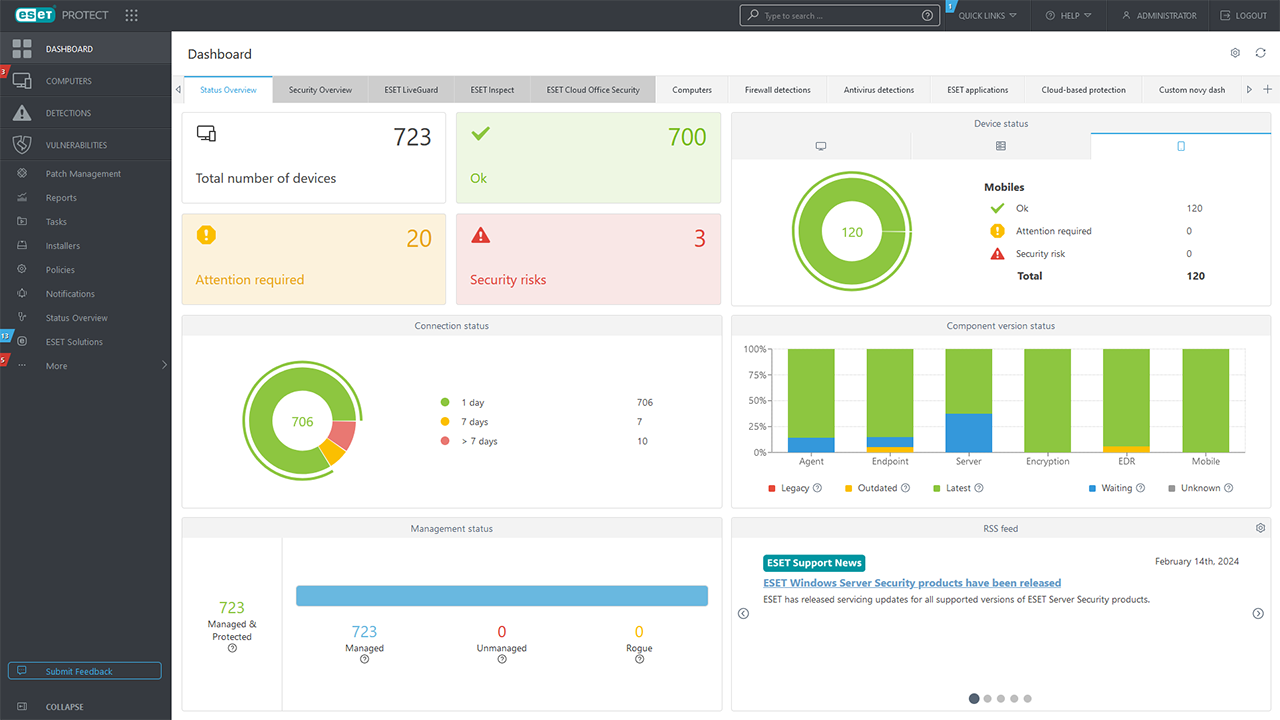
The ESET PROTECT console is the gateway to managing Linux endpoints, providing a comprehensive dashboard for policy application, incident alerts, and compliance reporting across the network.
ESET Endpoint Antivirus vs. Advanced EDR Suites: Feature Focus
ESET Endpoint Antivirus for Linux is a robust EPP solution, differentiating itself from EDR-focused products like Sophos and Bitdefender by prioritizing stability, low resource use, and core anti-malware efficacy over forensic depth.
| Feature / Metric | ESET Endpoint Antivirus for Linux | Advanced EDR Suites (e.g., Sophos/Bitdefender) |
|---|---|---|
| Primary Focus | EPP (Endpoint Protection Platform)—Prevention and Core Malware Detection. | EDR/XDR—Detection, Threat Hunting, Behavioral Analysis, and Forensic Response. |
| Resource Utilization | Extremely Low Footprint—Key advantage for servers. | Generally Low, but higher resource demand due to continuous behavioral monitoring. |
| Detection Technology | ThreatSense® (Signatures, Advanced Heuristics, Emulation). | Deep Learning/AI, Behavioral Monitoring, Anti-Exploit, Ransomware Rollback. |
| Advanced Response | Remote Scan/Quarantine, System Logs via Console. | Live Response (Remote Shell), Attack Graph Visualization, Root Cause Analysis. |
| Management | ESET PROTECT (Highly intuitive and mature centralized console). | Cloud-native consoles with Data Lake/SIEM focus. |
ESET Endpoint Antivirus for Linux – Suitability and Technical Verdict
- Best For: Organizations (especially large academic, public sector, or traditional IT environments) prioritizing minimal system impact, proven core anti-malware efficacy, and a highly stable, integrated **cross-platform management console** for their Linux endpoint fleet.
- Key Differentiator: The consistently small operational footprint and the mature, easy-to-use ESET PROTECT management interface, which provides exceptional control without the complexity often found in EDR tools.
- Area for Consideration: It lacks the full, modern **EDR/XDR** features (like deep forensic threat hunting, AI-driven behavioral threat scoring, or live terminal response) found in top-tier competitors, making it a stronger choice for prevention than for complex, post-breach investigation.
Conclusion: Stability, Performance, and Proven EPP
ESET Endpoint Antivirus for Linux remains a formidable and highly practical security solution in the enterprise Linux market. It deliberately focuses on perfecting the fundamentals: providing **rock-solid anti-malware prevention** with an unmatched dedication to **performance efficiency**. For IT managers whose primary concern is protecting production Linux servers and workstations without introducing resource contention or management complexity, ESET’s offering is a clear winner. Its centralized management via the ESET PROTECT console simplifies security operations across the entire enterprise, making ESET a highly reliable, mature, and cost-effective EPP choice for comprehensive cross-platform protection.
Final Verdict: Top-Tier EPP for Resource-Sensitive Linux Fleets
/ 10.0
ESET Endpoint Antivirus for Linux earns an excellent 9.4/10.0 rating. This score reflects its market-leading **low system impact**, the reliability of its proven **ThreatSense® engine**, and the powerful centralization offered by the **ESET PROTECT** platform. It is the premier choice for organizations that value stability and performance above all else in their Linux endpoint security.
Secure Your Linux Endpoints with ESET’s Proven, Lightweight Protection
Deploy ESET Endpoint Antivirus for Linux today to benefit from centralized control and low resource usage across your server and workstation fleet.