

Bitdefender GravityZone (Linux) Review – Enterprise EDR and EPP for Modern Linux Infrastructure
Bitdefender GravityZone is an enterprise-grade cybersecurity platform that offers comprehensive Endpoint Protection Platform (EPP) and Endpoint Detection and Response (EDR) capabilities, with dedicated and highly rated support for Linux operating systems. Unlike traditional Linux antivirus solutions (like ClamAV), GravityZone provides a multi-layered defense including tunable machine learning (**HyperDetect**), behavioral analysis, real-time file access monitoring, and the ability to correlate threats across the entire environment via a centralized, cloud-based management console (**Control Center**). It is designed specifically for organizations that utilize Linux for mission-critical servers (web, database, mail), public cloud workloads, and containerized environments. The Linux agent, known as **BEST (Bitdefender Endpoint Security Tools)**, is lightweight, ensures minimal performance impact, and is essential for organizations seeking to achieve **high regulatory compliance** and **proactive threat hunting** across their heterogeneous (Windows, macOS, Linux) infrastructure.
KEY TECHNICAL NOTE: Linux Agent (BEST) Design. The Bitdefender Endpoint Security Tools (**BEST**) agent for Linux is a robust, purpose-built component that provides crucial kernel-level integration. It supports a wide range of Linux distributions (RHEL, CentOS, Ubuntu, Debian, SUSE) and kernel versions by utilizing the fanotify kernel option or DazukoFS fallback for on-access scanning. This deep integration is what separates an enterprise EPP like GravityZone from simple command-line scanners, enabling **real-time process monitoring**, **network attack defense**, and **automated response actions** like file quarantine and endpoint isolation directly from the **GravityZone Control Center**.
Core Features: Deep Protection for Linux Servers
GravityZone’s Linux coverage goes far beyond traditional signature-based detection, providing the kind of deep context and automation required for modern data center and cloud security.
| Core Component | Technical Detail | Role in Security Efficacy |
|---|---|---|
| Endpoint Detection & Response (EDR) | Continuously monitors Linux server activity (processes, network connections, file access) and automatically correlates suspicious events into actionable **incidents**. Provides security teams with a graphical, historical view of the attack chain to quickly understand the **root cause** and impact. | |
| HyperDetect Tunable AI | Machine Learning & Behavior Analysis | A pre-execution layer of defense that utilizes machine learning models to detect **fileless attacks**, **zero-day exploits**, and **living-off-the-land** techniques before they can execute. This is critical on Linux servers often targeted by SSH brute-force and remote code execution exploits. |
| Network Attack Defense (NAD) | Traffic Inspection & Exploit Blocking | Monitors network packets and traffic patterns to detect and block malicious network activity, including attempts to exploit vulnerabilities, port scanning, and brute-force attacks. **This acts as a host-based firewall/IPS for the Linux server.** |
| Security for Containers | Host-based Container Visibility | GravityZone extends protection to containerized environments (Docker, Kubernetes) running on Linux hosts. It ensures the **host OS (the foundation of the containers)** is protected, offering visibility into the entire workload and preventing malware escaping the container or compromising the host kernel. |
Management and Operational Efficiency
The strength of GravityZone lies in its unified management and low administrative overhead for diverse environments.
Centralized Control Center and Visibility
- Unified Console: All Windows, macOS, and Linux endpoints are managed from a single cloud-based console, streamlining policy deployment, monitoring, and reporting. This eliminates the need for separate tools for different operating systems.
- Risk Management: The console provides a **Security Risk Score** for each Linux server, highlighting vulnerabilities, misconfigurations, and risky user behaviors (e.g., running outdated kernel versions or insecure services), prioritizing necessary fixes.
- Automated Response: Security teams can trigger immediate, automated response actions from the console on a compromised Linux server, such as **isolating the endpoint** from the network or remotely running scans and clean-up tasks.
- API and Integrations: GravityZone offers extensive API support, allowing for seamless integration with SIEM (Security Information and Event Management) and SOAR (Security Orchestration, Automation, and Response) platforms, crucial for large enterprise IT environments.
Performance and Resource Footprint on Linux
The BEST Linux agent is architected for efficiency, which is vital for high-performance servers that cannot tolerate resource spikes.
- Lightweight Agent: The agent is designed to be minimal. Recommended resource requirements for the agent are **4GB of RAM** and **2.5GB of free disk space** for a base Antimalware installation on a Linux server.
- Scanning Efficiency: By leveraging kernel-level mechanisms (like **fanotify**), on-access scanning is highly optimized, only scanning files when they are accessed or modified, ensuring the overhead is minimal during periods of heavy server load.
- Cloud Offloading: Updates and complex analyses are often handled by Bitdefender’s cloud services, reducing the local processing load on the Linux endpoint itself.
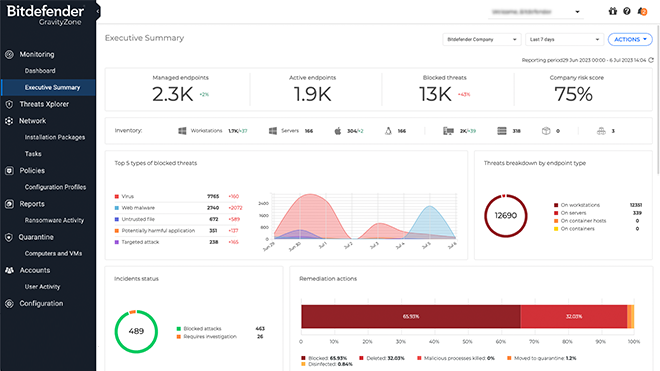
The GravityZone Control Center provides security teams with a unified dashboard for managing and responding to threats across all operating systems, including deep forensic data for Linux server incidents.
Bitdefender GravityZone vs. ClamAV: A Comparison of Security Layers
GravityZone and ClamAV are not competitors; they address two different security needs within the Linux ecosystem—commercial EDR versus open-source gatekeeping.
| Feature / Metric | Bitdefender GravityZone (Linux) | ClamAV (Open-Source Engine) |
|---|---|---|
| Primary Security Layer | Endpoint Protection Platform (EPP) & **EDR** | **Anti-Malware Scanning Engine** & Mail Gateway Filter |
| Real-Time Protection | **Yes**, kernel-level on-access and behavioral monitoring. | No, primarily **manual/scheduled** or daemon-based static file scan. |
| Detection Technology | **AI/ML (HyperDetect)**, Behavioral Analysis, Signatures, Advanced Anti-Exploit. | Traditional **Signatures** and simple Heuristics. |
| Management/Visibility | **Centralized Cloud Console** (GUI), Threat correlation, Forensic data. | **Command-line Interface (CLI)**, Local logs only, no centralized management. |
| Cost/Licensing | **Subscription-based** (Server licenses count differently than desktops). | **Free** and Open-Source. |
GravityZone – Suitability and Technical Verdict
- Best For: Organizations (SMB to Enterprise) running critical **Linux servers (web, database, cloud workloads)** that require modern, auditable EDR protection, unified security policy enforcement, and compliance reporting across mixed OS environments.
- Key Differentiator: The integration of **advanced AI/ML-driven behavioral detection** and **full EDR visibility** directly onto the Linux kernel, a capability few commercial vendors execute successfully.
- Area for Consideration: The **initial setup and configuration** for on-premises deployments of the GravityZone Control Center can be complex, and it is a paid, subscription-based service, unlike its open-source counterparts.
Deployment and Security Recommendations (Linux)
Effective deployment involves selecting the right platform and configuring policies appropriate for the role of the Linux machine (server vs. workstation).
Installation & Best Practices
- Installation Type: Agents are typically deployed using a simple script generated from the **GravityZone Control Center** that handles all dependencies and kernel integration.
- Server vs. Workstation Policies: Deploy **stricter policies** on publicly exposed Linux servers (e.g., enabling **HyperDetect** in aggressive mode) compared to internal Linux workstations.
- Exclusions: Critically important on Linux. Configure exclusions for known, high-I/O directories or processes (e.g., MySQL data directories, log folders like
/var/log) to prevent performance degradation, while carefully managing the security risk. - Patch Management: Utilize GravityZone’s integrated **Patch Management** module to ensure the Linux OS and key applications are kept up-to-date, addressing vulnerabilities before they can be exploited.
Conclusion: Unifying Security for Heterogeneous Networks
Bitdefender GravityZone for Linux is a **premium, necessary tool** for any modern enterprise managing a mixed fleet of operating systems, or running critical workloads on Linux. It successfully bridges the gap between traditional Linux antivirus (signature-only) and the demands of modern threats (fileless, zero-day). By offering high-performance, real-time protection, and deep EDR forensics—all managed from a unified cloud console—it delivers the **security visibility and control** required to meet the challenges of sophisticated cyber-attacks across the entire organization.
Final Verdict: Top-Tier EDR for Linux Environments
/ 10.0
Bitdefender GravityZone (Linux) receives an outstanding 9.7/10.0. It is a **leading choice** for providing enterprise-grade **EDR and EPP on Linux servers**, a segment often overlooked by competitors. The unified management, low-impact kernel-level monitoring, and top-tier threat detection (consistently validated by industry tests) make it an indispensable solution for security-conscious IT and DevOps teams.
Elevate Your Linux Security to the Enterprise Level
Deploy Bitdefender GravityZone to gain centralized control, real-time threat correlation, and advanced behavioral defense for your critical Linux servers and cloud infrastructure.