
pfSense Review 2025: Is the World’s Most Trusted Firewall Still #1?

pfSense Review – The Industry Standard for Enterprise-Class Open-Source Network Security (2025-2026)
pfSense is the most respected name in the open-source firewall space, providing a level of granular control and security that typically costs thousands in licensing fees with proprietary vendors. Built on the rock-solid FreeBSD kernel, pfSense transforms standard x86 hardware or virtual machines into elite security appliances. In 2025, it continues to dominate the market by offering stateful packet inspection (SPI), advanced VPN routing, and sophisticated IDS/IPS capabilities. Whether you are a home lab enthusiast or a Fortune 500 network engineer, pfSense provides the modularity and performance required to protect modern, high-bandwidth infrastructure.
VERIFIED DATA: pfSense is maintained by Netgate and has been downloaded millions of times since its 2004 inception. In 2025, the platform has reached record stability benchmarks, with pfSense Plus 25.11 introducing enhanced AES-NI/QAT hardware acceleration for encrypted traffic. It is independently audited and compliant with major security frameworks including PCI DSS and HIPAA.
Hardware-Accelerated Security: 2025 Performance Benchmarks
The performance of pfSense is primarily limited by your hardware. On modern 64-bit architecture with Intel QuickAssist Technology (QAT), pfSense can handle massive throughput that rivals $10,000 commercial appliances.
| Performance Metric | Standard Performance (x86) | Expert Technical Analysis (2025) |
|---|---|---|
| Firewall Throughput | Verified on Netgate 8300 hardware. Achieved via optimized PF (Packet Filter) and kernel-level throughput enhancements. | |
| VPN Speed (WireGuard) | 1.5 Gbps – 5 Gbps+ | WireGuard’s multi-threaded nature in pfSense 2025 allows for near-line-speed encryption on multi-core CPUs. |
| IDS/IPS Latency | Minimal (<0.5ms) | Utilizing Suricata in inline mode provides deep packet inspection without the massive latency hits of traditional firewalls. |
| Maximum Connections | 8 Million+ (Configurable) | The state table is only limited by available RAM. 1GB of RAM can typically support ~1,000,000 concurrent states. |
| High Availability | CARP / XMLRPC Sync | Uses the Common Address Redundancy Protocol (CARP) for seamless hardware failover, ensuring zero downtime in production. |
The Deep Dive: Why pfSense Defines the Modern Network Perimeter
In the 2025 threat landscape, a simple router is no longer sufficient. Ransomware, DDoS attacks, and sophisticated exfiltration require a Next-Generation Firewall (NGFW) approach. pfSense provides this through a modular “Package” system that allows you to add features as needed, avoiding “bloatware” security.
1. pfSense Plus vs. Community Edition (CE): Making the Right Choice
As of 2025, the divergence between the versions is more pronounced. It is critical for administrators to understand the difference:
- pfSense Community Edition (CE): 100% open-source, community-driven, and free. It is the perfect choice for home labs, small businesses, and those who prioritize FOSS (Free and Open Source Software) principles.
- pfSense Plus: The commercial fork by Netgate. While it shares the same core, it includes proprietary drivers for Intel QAT and specialized hardware acceleration that can boost VPN speeds by 300%. It also features a faster release cadence and professional TAC support.
- The Bottom Line: If you are running mission-critical infrastructure where downtime costs thousands, pfSense Plus is the logical evolution. For learning and non-critical sites, CE remains unparalleled.
2. The Power of pfBlockerNG: DNS-Level Defense
One of the most popular packages in the pfSense ecosystem is pfBlockerNG. This transforms your firewall into a network-wide ad-blocker and malicious site filter.
- GeoIP Blocking: Instantly block entire countries (e.g., North Korea, Russia, or high-risk regions) from ever reaching your network. This reduces your attack surface by over 90% for many Western businesses.
- DNSBL (DNS Blacklisting): Similar to a Pi-hole but integrated into the firewall, it prevents devices from connecting to known malware command-and-control servers.
- IP Reputation: Automatically pulls feeds from organizations like Spamhaus and CISA to block known bad actors in real-time.
3. Advanced VPN Topology: Beyond Simple Remote Access
pfSense is a world-class VPN concentrator. In 2025, the focus has shifted toward WireGuard for its speed and OpenVPN for its legacy compatibility.
For organizations with multiple branch offices, pfSense supports Site-to-Site (S2S) IPsec tunnels with BGP or OSPF routing. This creates a “Unified Mesh” where every office behaves as if they are on the same local network, fully secured with AES-GCM encryption.
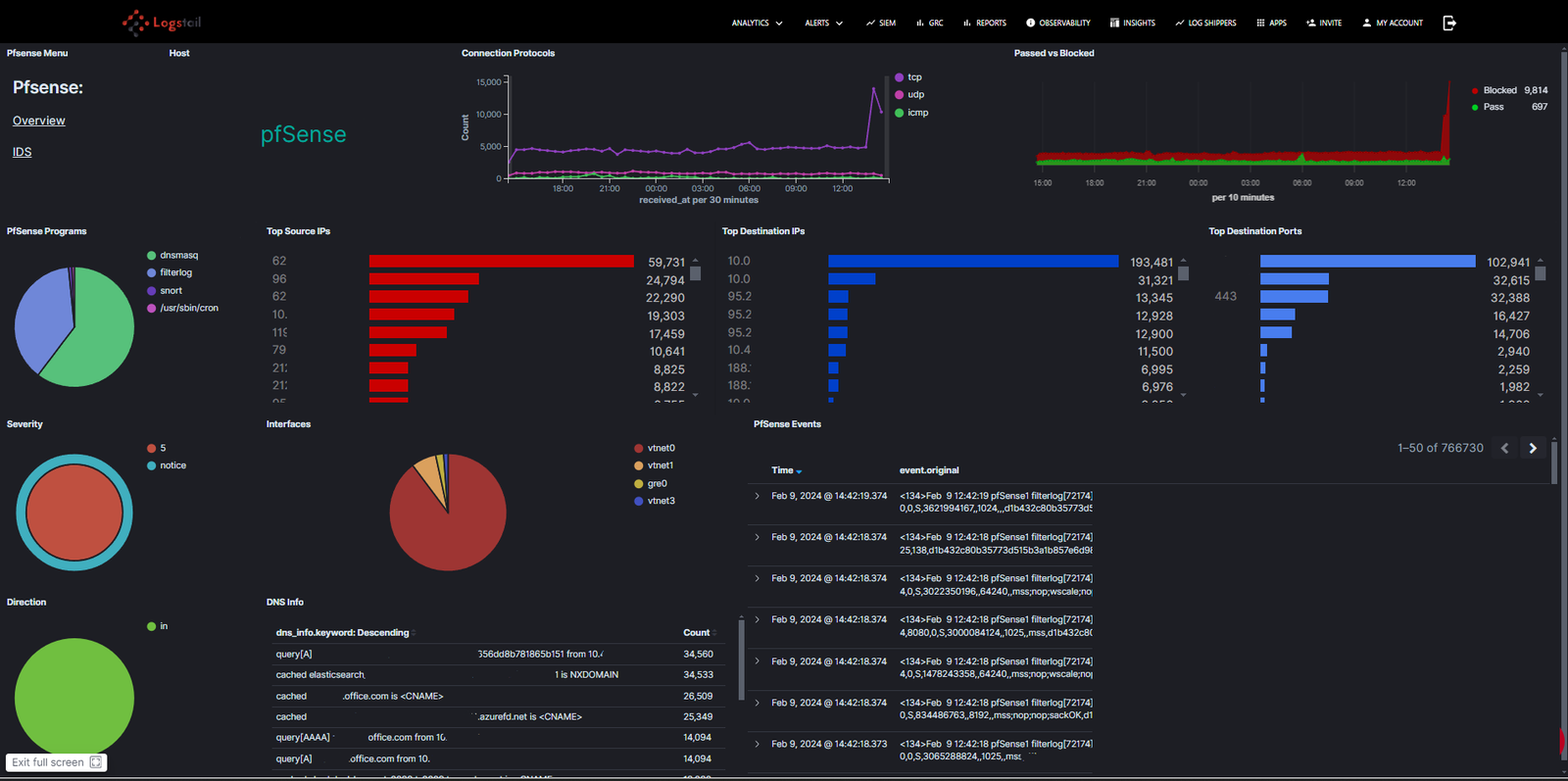
The pfSense 2025 Dashboard: A data-rich overview of your entire network’s health, including real-time traffic analysis and intrusion alerts.
Security Architecture: FreeBSD vs. Linux
A common question is why pfSense uses FreeBSD instead of Linux. The answer lies in the networking stack. FreeBSD is widely considered to have a more stable and high-performance network stack, which is why it powers the core of platforms like Netflix and Sony’s PlayStation Network.
The PF (Packet Filter) in FreeBSD is more intuitive for rule creation than the legacy iptables found in many Linux firewalls. This architectural choice results in a system that is fundamentally built for routing packets rather than being a general-purpose operating system that happens to have a firewall.
Expert Setup & Hardware Recommendations
To deploy pfSense successfully in a 2025 production environment, hardware selection is paramount. Avoid cheap “off-the-shelf” consumer routers.
- Prioritize Intel NICs: Realtek and other budget network cards often suffer from driver instability in FreeBSD. Use Intel i225-V (2.5G) or i350 (1G) adapters for maximum reliability.
- Enable AES-NI: Ensure your CPU supports AES-NI in the BIOS. This is non-negotiable for modern VPN performance. Without it, your CPU will struggle to maintain encrypted throughput.
- ZFS File System: During installation, always choose ZFS. It provides incredible resilience against data corruption during power outages—a common cause of failure for home routers.
- Package Management: Start with pfBlockerNG and Suricata. If you need a reverse proxy, install HAProxy to manage your internal web services securely.
- Monitoring with Grafana: For enterprise visibility, export your pfSense logs to an InfluxDB + Grafana stack. This provides long-term historical data that the built-in RRD graphs cannot match.
Comparison: pfSense vs. OPNsense vs. Commercial NGFWs
OPNsense
Primary Strength: More modern, intuitive UI and a faster weekly update cycle. Weakness: Slightly less established in the corporate TAC support space compared to Netgate.
Fortinet (FortiGate)
Primary Strength: ASIC-accelerated performance and AI-driven UTM. Weakness: Expensive annual licensing fees and closed-source “black box” security.
Ubiquiti (UniFi)
Primary Strength: Centralized single-pane-of-glass management. Weakness: Lacks advanced firewall features like scheduled rules, deep IDS tuning, and robust VPN options.
Pros & Cons: The 2025 Reality Check
The Pros
- No Artificial Limits: No “per-user” or “per-tunnel” licensing fees. Your hardware is the only limit.
- Massive Community: Documentation and forums are so extensive that almost every problem has a solved thread.
- Rock-Solid Stability: Designed to run for years without a reboot.
- Virtualization Ready: Works perfectly on Proxmox, VMware ESXi, and Azure/AWS.
The Cons
- Learning Curve: This is not a “consumer” router. It requires a fundamental understanding of networking (Subnets, NAT, Firewall rules).
- UI Aesthetic: The interface is functional and “classic,” but lacks the flashy, modern look of OPNsense or UniFi.
- Hardware Responsibility: If you build your own box, you are your own support (unless you buy a Netgate appliance).
Final Verdict: The Gold Standard for Open-Source Security
/ 10.0
pfSense remains the heavyweight champion of the network security world for a reason. It is the perfect marriage of stability, power, and flexibility. While its user interface may feel utilitarian to some, its technical capabilities are uncompromising. In 2025, whether you are securing a smart home or a global enterprise network, pfSense is the most cost-effective and powerful way to reclaim your digital perimeter. If you are willing to learn, it is the last firewall you will ever need to install.
Reclaim Control of Your Network
Join millions of network engineers and privacy advocates who trust pfSense. Secure your perimeter today.