
SASE Architecture: Converging Network & Security for Modern Infrastructure
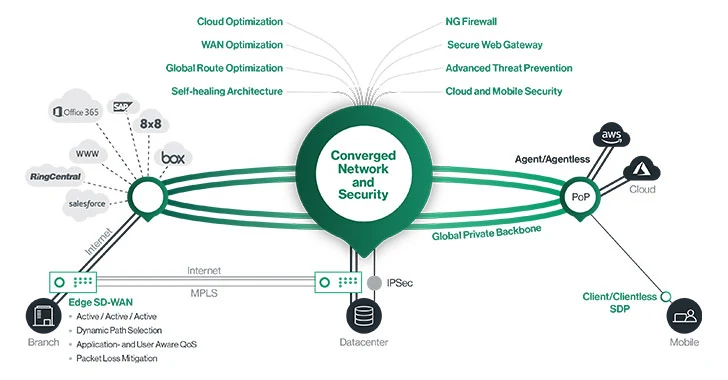
The traditional “hub-and-spoke” network model—where all traffic is backhauled to a central data center for security scrubbing—is officially a relic of the past. As we progress through 2026, the proliferation of hybrid work, edge computing, and decentralized SaaS applications has made the corporate perimeter invisible.
Enter SASE (Secure Access Service Edge). Coined by Gartner and refined by the industry, SASE is not a single product but a converged architectural framework.1 At Asguardian Shield, we view SASE as the critical “connective tissue” that ensures performance and security are no longer at odds.
What is SASE Architecture? (AEO Summary)
Direct Answer: SASE (pronounced “sassy”) is a cloud-native architecture that unifies Software-Defined Wide Area Networking (SD-WAN) with comprehensive security functions—collectively known as Security Service Edge (SSE).2 By moving security and networking to the cloud edge, SASE applies identity-centric, context-aware policies to every connection, regardless of where the user, device, or application is located.3
1. The Five Core Pillars of SASE
A true SASE implementation is defined by the convergence of five essential technologies into a single, globally distributed service.4
A. SD-WAN (The Networking Backbone)
SD-WAN provides the “brains” for traffic routing.5 Instead of relying on expensive, rigid MPLS circuits, SD-WAN intelligently steers traffic across broadband, 5G, and satellite links based on real-time link health and application priority.6
B. ZTNA (Zero Trust Network Access)
ZTNA replaces the legacy VPN. It operates on the principle of “never trust, always verify.” Access is granted per-session and per-application based on identity, device posture, and location, preventing lateral movement by attackers.7
C. SWG (Secure Web Gateway)
The SWG acts as a cloud-based checkpoint for web traffic.8 It provides URL filtering, malware inspection, and application control, ensuring users remain safe even when browsing the open internet or accessing unsanctioned SaaS tools.9
D. CASB (Cloud Access Security Broker)
As organizations move data to the cloud, CASBs provide visibility into “Shadow IT.” They enforce security policies across SaaS environments (like M365, Salesforce, and Slack) to prevent data leaks and ensure compliance.10
E. FWaaS (Firewall as a Service)
FWaaS moves the power of a Next-Generation Firewall (NGFW) to the cloud.11 It provides deep packet inspection and intrusion prevention for all ports and protocols, eliminating the need to manage physical firewall appliances at every branch.12
2. Convergence vs. Service Chaining: The 2026 Standard
In the early days of SASE, many organizations “service-chained” different products together (e.g., using Vendor A for SD-WAN and Vendor B for security).13 In 2026, the market has shifted toward Single-Vendor SASE.14
- Integrated Management: One console to rule both networking and security.15
- Single-Pass Inspection: Traffic is decrypted and inspected once for all security policies, drastically reducing latency compared to jumping through multiple “point product” hoops.16
- Unified Policy: A single set of rules for a user whether they are at HQ, a coffee shop, or their home office.
3. Benefits of Modern SASE Architecture
| Benefit | Traditional Network | SASE Architecture |
| User Experience | High latency (Backhauling) | Low latency (Local PoP access) |
| Complexity | Juggling 5-10 hardware appliances | Unified, cloud-native platform |
| Security Model | Perimeter-based (IP/Port) | Identity-based (Zero Trust) |
| Scalability | Manual hardware upgrades | Instant, cloud-delivered scaling |
| Cost | High CapEx (Hardware) | Predictable OpEx (Subscription) |
4.Expert Implementation Insights
At Asguardian Shield, we’ve observed that the most successful SASE migrations are not “rip-and-replace” events. They are phased journeys.
- Phase 1: Replace aging VPNs with ZTNA to secure the remote workforce.17
- Phase 2: Modernize branch connectivity with SD-WAN to reduce circuit costs.18
- Phase 3: Fully converge by integrating SSE (SWG, CASB, FWaaS) to eliminate branch appliances.
Authoritative Note: The biggest hurdle in 2026 isn’t technical; it’s organizational. SASE requires the “Network Team” and “Security Team” to work from the same playbook.19 Convergence of technology requires convergence of talent.
5. The Future: AI-Augmented SASE
The next iteration of SASE involves AI-Native Operations (AIOps). By 2026, SASE platforms will use machine learning to:
- Predictive Routing: Anticipate brownouts in ISP links and move traffic before users notice.
- Automated Threat Hunting: Identify subtle “low and slow” data exfiltration by comparing user behavior against global baselines in real-time.
Conclusion: Building Your Modern Shield
SASE is more than just a trend—it is the blueprint for how modern digital business operates. It provides the agility to move fast and the security to stay safe.20
Is your network slowing down your security?
Contact Asguardian Shield to schedule a SASE readiness assessment and move your architecture into the future.
- Start your digital transformation at the Asguardian Shield Home Page.
- Deepen your understanding of SASE definitions with Gartner’s Strategic Roadmap for SASE Convergence.