

Trend Micro Cloud One – Workload Security Review – Deep Server Protection, Virtual Patching, and CNAPP Integration
Trend Micro Deep Security, now part of the Trend Micro Cloud One – Workload Security platform, is a comprehensive security solution explicitly designed for hybrid cloud, data center, and server environments. It moves beyond standard Endpoint Protection (EPP) by offering a multi-layered security stack that includes critical server-centric modules like Intrusion Prevention System (IPS) for Virtual Patching, File Integrity Monitoring (FIM), and Application Control. Its strongest differentiator is the Virtual Patching capability, which shields servers from known vulnerabilities immediately, giving IT teams crucial time to test and apply vendor patches without downtime. The solution integrates deeply with major cloud providers (AWS, Azure, GCP) and container orchestrators (Kubernetes), supporting automated security deployment and governance. While it integrates with Trend Vision One for XDR, its core strength lies in providing a dense set of preventive controls tailored for the unique stability and compliance needs of servers and workloads.
KEY TECHNICAL NOTE: The Power of Virtual Patching. Trend Micro’s reputation is built largely on its proprietary Intrusion Prevention System (IPS) rules engine which acts as a virtual shield. When a new vulnerability (like a critical Apache or Samba flaw) is announced, Trend Micro’s Zero Day Initiative (ZDI) quickly deploys IPS filters. This filter intercepts and blocks exploit attempts targeting the vulnerability at the network layer, preventing the attack payload from reaching the vulnerable service. This means your Linux server is protected instantly, buying your patching team weeks or months to apply the official vendor patch on their own schedule, avoiding emergency patching and downtime. This capability is paramount for organizations running mission-critical or legacy Linux servers.
Core Protection Modules: Server-Centric Defense
Workload Security provides a dense stack of security controls, with features specifically chosen and optimized for server and cloud compliance requirements (like PCI DSS, HIPAA, GDPR).
| Core Component | Technical Detail | Role in Server Security and Compliance |
|---|---|---|
| Intrusion Prevention (IPS) | Inspects all inbound/outbound traffic at the server host. Blocks network exploits, code injection, and DoS attempts. Its unique strength is applying virtual patches to prevent exploitation of OS and application vulnerabilities before official vendor patches are deployed. | |
| File Integrity Monitoring (FIM) | Real-Time File and Registry Baseline Monitoring | Monitors and alerts on unauthorized or suspicious changes to critical system files, configuration files (e.g., /etc/passwd, web roots), and application data. This is mandatory for compliance standards like PCI DSS Requirement 11.5 and helps detect rootkits or backdoor installation. |
| Anti-Malware & NGAV | Behavioral Analysis, Machine Learning, and Pattern Matching | Provides high-efficacy real-time scanning against malware, ransomware, and cross-platform threats (detecting Windows threats residing on Linux file shares). Uses Trend Micro’s Smart Protection Network (SPN) cloud intelligence. |
| Application Control | Dynamic Trust List Generation (Whitelisting) | Blocks all unapproved executables and scripts from running on high-value servers. Since server configurations are often static, this drastically reduces the attack surface and prevents execution of malware or unauthorized lateral movement tools. |
Cloud Native Management and Deployment
Trend Micro Cloud One is a SaaS platform built for cloud scalability, enabling security teams to embed protection within their DevOps workflow.
Deep Cloud and Container Integration
-
◆
Cloud Connectors: Connects directly to AWS, Azure, and Google Cloud accounts to automatically discover new VMs, apply security policies based on cloud tags/labels, and manage the security of dynamic workloads (e.g., auto-scaling groups). -
◆
Agentless Protection (VMware): For VMware vSphere environments, Trend Micro can deploy a Virtual Appliance that protects VMs without installing an agent on the guest OS. This reduces resource consumption (no scan storm) and simplifies management. -
◆
DevOps Automation: Provides extensive APIs and integration with popular tools like Ansible, Chef, and Puppet to bake the security agent and policy assignment directly into the golden images or deployment scripts.
Trend Vision One XDR Integration
While Workload Security is the EPP/CWP for servers, its telemetry feeds directly into the Trend Vision One platform, providing Extended Detection and Response (XDR) capabilities.
- Centralized Telemetry: Data from the Linux server agent (FIM alerts, IPS blocks, malware detection) is correlated with data from endpoints, email, and cloud security sources.
- Attack Path Visualization: Vision One uses this data to map out an entire attack path, showing how a threat moved from, for instance, a compromised email to a Linux server, providing analysts with actionable context.
- Managed XDR Services: Customers can leverage Trend Micro’s 24/7 Managed Detection and Response (MDR) analysts to actively hunt and respond to threats found on their Linux and cloud workloads.
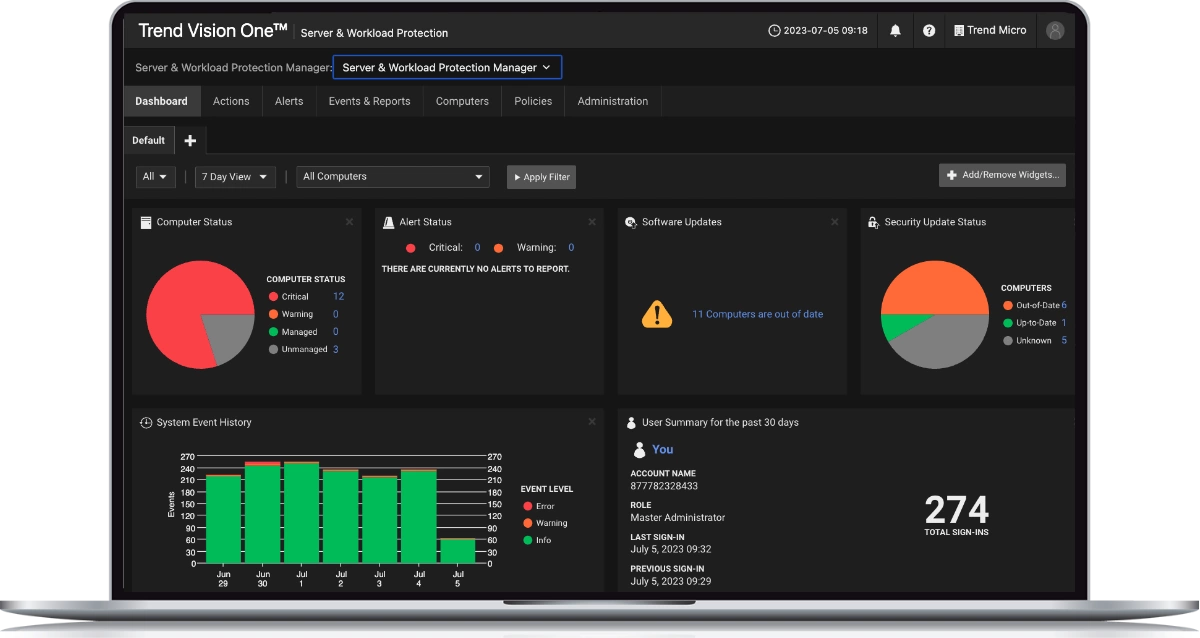
The Cloud One Console centralizes policy management, reporting, and security alerts for Linux, Windows, and container workloads across all cloud providers.
Trend Micro vs. Microsoft Defender for Endpoint: Key Differences
When comparing Trend Micro’s CWP solution to Microsoft Defender’s EDR, the choice often comes down to environment type and primary security goals.
| Feature / Metric | Trend Micro Cloud One – Workload Security | Microsoft Defender for Endpoint (Linux) |
|---|---|---|
| Primary Focus | CWP (Cloud Workload Protection) & Compliance—Multi-layered Server Controls. | EDR/XDR & NGAV—Cloud-Native Telemetry and Response. |
| Flagship Feature | Virtual Patching (IPS) to protect unpatched vulnerabilities. | Advanced Hunting (KQL) and deep Microsoft ecosystem integration. |
| File Integrity Monitoring (FIM) | Built-in, strong FIM module ideal for PCI compliance. | Available via Defender for Cloud or Log Analytics (less native). |
| System Impact | Generally low, with optional Agentless mode for VMs (VMware) to eliminate overhead. | Low footprint using eBPF, but its XDR sensor is always active. |
Trend Micro Workload Security – Suitability and Technical Verdict
Best For: Enterprises with mixed virtualization technologies (VMware, Hyper-V, Cloud) and strong regulatory compliance drivers (e.g., finance, healthcare). It is the superior choice when the primary goal is protecting against exploitation of unpatched vulnerabilities and needing built-in FIM, IPS, and Application Control for servers.
Conclusion: The Gold Standard for Server Hardening
Trend Micro Cloud One – Workload Security carries on the legacy of Deep Security as the leading platform for server and cloud workload hardening. No other solution offers the same depth and maturity across server-specific controls like Virtual Patching and integrated File Integrity Monitoring. While its EDR capabilities are delivered through the overarching Vision One platform, the core Workload Security agent is a powerful prevention tool designed to keep critical servers running securely, even when patching schedules are delayed. For organizations running a diverse Linux fleet in a hybrid or multi-cloud environment, Trend Micro provides the stability, control, and compliance features needed to manage risk effectively.
Final Verdict: Unrivaled Vulnerability Shielding for Workloads
/ 10.0
Trend Micro Cloud One – Workload Security earns an exceptional 9.6/10.0 rating. This score reflects its unmatched strength in Virtual Patching for vulnerability shielding, its comprehensive suite of server-centric controls (FIM, IPS, Application Control), and its native integration with leading cloud platforms. It is the premier choice for compliance-driven, hybrid cloud security.
Shield Your Servers Against Zero-Day Exploits with Virtual Patching
Explore Trend Micro Cloud One to unify security for your virtual machines, cloud workloads, and containers under one platform.